research
Our team's goal is to design, develop, manufacture, and test improved devices and materials for a wide range of applications. We have themes across additive manufacturing, soft materials, and robotics with key applications ranging from human health to outer space.
We place an emphasis on using scalable manufacturing strategies and advancing additive manufacturing technologies. We have a particular interest in leveraging robotics and other techniques to enable multiscale design of materials.
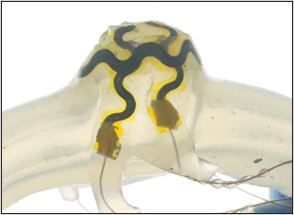
Among human health applications, we focus on the vascular system, where we build implantable (and practical) sensors for health monitoring. We also integrate sensors, robotics, and soft materials to create advanced medical simulators.
Regarding space, we design and apply soft composite materials (such as liquid metal embedded elastomers) to endure extreme environments and create space-grade soft electronics.

COLLABORATORS
Adrian Stein - LSU
Bruno Rego - LSU
Hector Ferral - LSU Health
Debkalpa Goswami – UT Graz
Sharjeel Chaudhry – Johns Hopkins
Chris Wohl and Valerie Wiesner – NASA Langley Research Center
BD Medical
FUNDING

SMART MEDICAL DEVICES
We are interested in developing manufacturing techniques to enable complex, multi-material structures and three-dimensional electronic architectures for biomedical devices, bio-interfaced electronics, and soft robotics. We are focused on adapting existing medical manufacturing technologies (rotational laser machining, wire braiding, and molding) and applying different printing techniques (aerosol jet, inkjet, direct ink writing, and more) to embed electronics and intelligence into well-established medical device structures.

VASCULAR electronics
Vascular diseases account for nearly a third of deaths across the world. By creating implantable vascular electronics, we can provide wireless and unobtrusive monitoring of vascular health and diseases. We aim to replace conventional vascular devices with smart electronic systems for remote sensing and actuation. We are also interested in developing soft electronics and robotics systems for design evaluations of vascular devices and treatments and for use in vascular disease models.

multi-MATERIAL printing
Printing offers the ability to pattern a wide range of materials in three-dimensional designs. We aim to harness this ability for bio-interfaced electronics and soft robotics. Included in this work is applying multi-axis, robot-assisted control of printing towards conformal printing and tuning of material systems. Beyond biomedical systems, the printing of electronics is of interest for in-space manufacturing.

WEARABLE electronics
Comfortable, soft electronics interfaced with the skin offer improved health monitoring, diagnostics, treatments, and rehabilitation. We are interested in printing wearable systems, applying three-dimensional structures, and creating patient-specific devices across a broad range of applications.

multifunctional MATERIALS
Soft, elastomeric materials filled with functional fillers, including liquid metal, can mimic biological materials and demonstrate exceptional mechanical, electrical, and thermal properties. We look at developing and characterizing functional materials for soft sensors and actuators.
